How-to guide
Handle resolution
A trading pool closes to swaps and added liquidity when its question ends; the market finalizes later, when its outcome is final. Use this guide from question end onward to turn LP tokens, complete sets, and winning shares into their redeemable assets.
Unwind after question end
- Remove your LP tokens from the trading pool into Yes and No shares (Remove liquidity).
- Redeem matching Invalid, Yes, and No as complete sets while the SecurityPool is
Operationaland its universe has not forked. If the universe forks while the question is unresolved, follow Handle a universe fork. - After the market finalizes, redeem the winning share through
SecurityPool.redeemShares, which requires the SecurityPool to beOperational. Keep redeeming through this pool if its universe forks later; resolved shares cannot migrate.
On an Invalid result, Invalid is the only winning share. Yes and No balances, including trading fees earned as LP, are worth nothing once they lose. Each redemption burns the redeemed shares and pays ETH at the SecurityPool's current collateral rate. A shared portfolio child can also pay recovery REP from its fork claim basket. The receipt can contain REP even when its ETH payout is zero; a new price report or an auction buyer is not required for redemption.
In the UI
Open the market. A closed market opens on its Settlement tab.
- To redeem complete sets, select Redeem sets, enter an amount in ETH to redeem (or Complete sets to redeem when the claim includes REP), check the ETH estimate and any Recovery REP, and select Redeem complete sets.
- Once the market finalizes, a Redeem Yes, Redeem No, or Redeem Invalid option appears for the winning outcome. It redeems your entire balance of that share through this exact SecurityPool. Before finalization the option is absent.
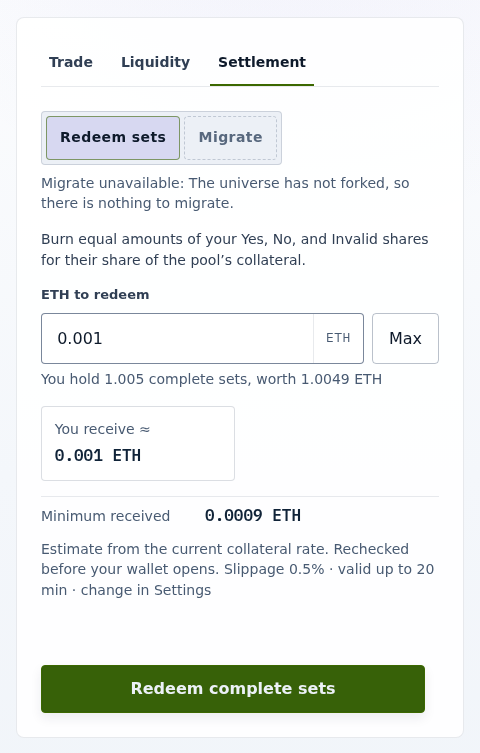
Check both asset balances in the selected universe after confirmation. REP recovery is shown separately from the portfolio’s ETH total. Every settlement transaction is simulated again at the latest block before your wallet opens, and stops if it would now fail.