How-to guide
Exit an insured position
Use this guide to turn Yes or No shares back into ETH while the market's trading pool is open. The exit spends one Invalid share for each complete set it redeems, so your Invalid balance limits it.
Connect your wallet and open Portfolio to discover Yes, No, Invalid and LP holdings across registered security pools in the selected universe, including pools never opened in this browser. Discovery covers the configured deployment; switch universes to inspect other branches. A failed balance read remains visible as unavailable rather than being counted as zero.
Exit in the UI
- Open the market, select Sell and the side you hold.
- Select Max to fill Shares to sell with the largest amount you can sell now, or enter a smaller amount. The hint under the field shows your holding and that limit.
- Check You receive ≈, Minimum received, and Invalid used, then select Sell Yes (or Sell No) and confirm.
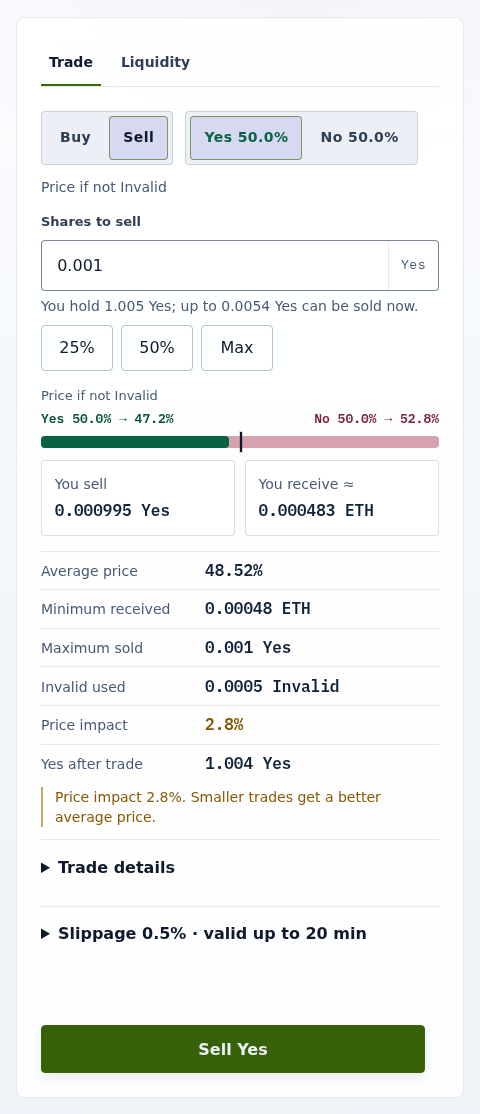
If Invalid is the binding limit and you enter more than it covers, the ticket shows Not enough Invalid shares to insure this sale. and offers Sell … instead with the largest amount. The shares you do not sell stay in your wallet. Acquiring more Invalid helps only when Invalid is the binding limit; Why early ETH exits are limited works through the bounds.
When the sale confirms, the Invalid balance under Your position has dropped by Invalid used and the ETH is in your wallet.
Exit through the SDK
- Call
maximumInsuredExitfrom the SDK, a private workspace package in this repository, with your wallet balances and the trading pool's reserves and fee. It returns the largest number of complete setsqthat your Invalid, your long shares, and the opposite reserve all allow. For a Yes position,qcomplete sets needqInvalid,qYes to redeem, and enough extra Yes to buy exactlyqNo. -
Choose
maxLongSharesIn,minEthOut,payoutRecipient,refundRecipient, anddeadlineexplicitly, and encode the request withencodeReceiveRequest. - Send a ShareToken
safeBatchTransferFromto the router carryingqInvalid andmaxLongSharesInlong shares with the encoded request. Simulate it, simulate again immediately before submission, and submit only if the result still satisfiesmaxLongSharesInandminEthOut.
The router reference lists the request fields, their constraints, and what the router delivers. A successful exit emits PositionExitedByTransfer with the long shares used and refunded.